online advertising Computer and IT Support

Monday, 19 January 2009

How To Improve Your Computer’s Performance In Win XP

Anyone who deals with the mystery machine (computer) knows that performance is always a problem. Performance problems tend to occur after using the computer for a while. The last performance problem, I had to deal with was for a friend whose computer suddenly went slow and kept displaying the message “Your system is low on virtual memory”. If you are one of those with a slow computer or just thinking of how to improve or optimise your computer’s performance, then here is the way to do it. The steps described here will also take care of the message above and enhance your computer’s performance.

What is a Virtual Memory (or Page File)?
Virtual memory or page file is an extension of the computer's physical memory (RAM*). The moment our total RAM or physical memory is used up, Windows automatically takes a small amount of hard drive space and uses it like a real memory. This frees up space in the RAM to load a new application. This enables us to run multiple programs at once.
Virtual memory is much slower than physical memory or RAM. When you don't have enough RAM, the operating system has to constantly swap information back and forth between RAM and the hard disk. This is called thrashing, and it can make your computer feel frustratingly slow.
By default, Windows automatically creates virtual memory or page file during installation. The size of the page file created is based on the amount of physical memory present at the time of installation. For example, Windows XP creates a virtual memory 1.5 times the size of RAM in the computer.
*RAM = Random Access Memory

Setting up Virtual Memory
Now, here is how to optimize your page files or virtual memory. Your main objective here is to improve system performance and also to avoid getting the message “Your system is low on virtual memory”.

1. Click Start, then open the Control Panel
2.Double click the System applet to open “System Properties”
3. Click the Advanced tab and then click Settings in the “Performance” section
4. Click the Advanced tab
5. Then click Change under the 'Virtual Memory' section. Here you can select any drive partition and set either ‘Custom’; ‘System Managed’ or ‘No page file’.
6. Finally, click Set before going on to the next partition. (always remember to click Set for changes to take effect)
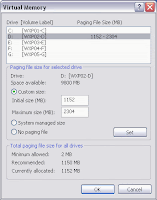
If you choose ‘Custom’, I recommend you do the following:
For Initial size (MB): Input at least 1.5 times the size of your current RAM
For Maximum size (MB): Input at least 2.5 to 3 times the size of your current RAM.
Do not go lower than the size of physical memory and if you are not very sure of what to do always choose “System managed size” and never under any circumstance select “No paging file”. Also, remember that virtual memory is measured in megabytes (1024 MB is equal to 1GB).


Finally, note that there are other ways of getting to the virtual memory section and the steps above is just one of them. To do this in Vista watch out for "How To Adjust Virtual Memory In Windows Vista" on this blog.
Thank you for reading and remember to leave your comments and subscribe.

By: Elliot Senya

Thursday, 15 January 2009

Understanding the Network Around You

Introduction
In this post I will be defining some commonly used terms that we come across in our day-to-day interaction with our networks both at home and in the office. I believe this will enhance your understanding of exactly what people mean when they mention such words.
The following definitions feature heavily in any form of network infrastructure.
I am very sure many advance users already know exactly what the following terms are but I’ll take the trouble to explain them again for the sake of those who are new to the topic.
**To open a link in new window, "Right Click" on the link and click on "Open Link In New Window"**

Wireless Network
Wireless networks enable a number of computers and devices to communicate with one another without the use of cables (wires) hence the name wireless. The most common type of wireless networks is the Wi-Fi (Wireless Fidelity) network. One of the main problems with wireless networks in their early days was speed of communication between devices within the network. But over the years this problem has been drastically improved through modern standards and technologies. The faster the network speed the quicker the movement of files and data between computers. These days most wireless signals including
Bluetooth devices transmit between frequencies of 2.4 and 5 GHz with data speeds up to 54 Mbps (megabits per second). Another issue was security of the wireless network but unfortunately I am not going to explore that area in this write up.


A typical representation of a wireless network (source: www.microsoft.com)

Some of the advantages of wireless networks include easy setup due to its simple nature, ability to add new stations with less technical difficulties, and freedom of movement for users as stations can be mobile (say laptop users).

But What Is A Network?
A network can be described as a group of computers and devices connected to enables us share resources such as information and data. Network components may include the following though not limited to these: Network Interface Card (NIC)*, Cables, Routers, Switches, Hubs, Servers and operating systems.
Please note that apart from cables, all the other components can be found in a wireless network. However a minimal amount of cables can be found in a wireless network. For example, the cable used to connect the wireless router to the computer or cables connecting to the
Internet Service Provider (ISP). Hence wireless networks are not totally devoid of cables as there are many circumstances where cables are used in other to achieve a desired purpose.
*Network Interface Card (NIC) can also be referred to as a network adapter.

Server
In general, a server is a computer program that provides services to other computer programs (and their users) in the same or other computers. This means that the server is the software component and not the hardware. Many people usually refer to the computer that a server program runs in as a server. It is also possible to run multiple servers on a single physical computer. For example, one computer on a network can be used to run a
Print Server and a Mail Server simultaneously.

Clients
A client is the requesting program or user in a
client/server relationship. This also defined by others as the computers that require services from the network. For example, a user of a Web browser is a client requesting for pages from servers all over the Web. The computer handling the request and sending back the HTML­ file is the server.

Access Points
Access points are the locations where network devices and computers can access the network. For a
local area network (LAN), an access point could be an Ethernet hub or switch and for a wireless network a wireless router. In a wireless network, multiple devices can connect to the network through a single access point.

Topology
This is the physical layout of the network. Common network topologies include bus, ring, star, tree, mesh and many more. Sometimes a network may consist of two or more topologies. This is known as hybrid topology.


An example of a network topology (source:
http://www.edrawsoft.com/)

Protocol
The simplest definition for a protocol would be given as the set of rules used to establish communication between network devices. It is also defined in other places as the standard that controls the connection and data transfer between network devices. The second definition is more of an extended version of the first. Protocols control almost every aspect of networking from software to hardware. They give meaning and direction to everything that goes on in the world of computing and networking. Common protocols include;
Internet Protocol (IP), Transmission Control Protocol (TCP), User Datagram Protocol (UDP), Hypertext Transfer Protocol (HTTP) and Dynamic Host Configuration Protocol (DHCP).
Others include
File Transfer Protocol (FTP), Telnet (Telnet Remote Protocol), Post Office Protocol version 3 (POP3), Simple Mail Transfer Protocol (SMTP), Internet Message Access Protocol (IMAP) and many more. In fact, there are thousands of them with new ones being developed year in year out by the Internet Engineering Task Force (IETF) and other similar organizations under the International Telecommunication Union (ITU).

Conclusion
Hope you leave this blog with a little bit more understanding of some of what the IT guys mean when they mention such words as server, protocol and all the rest. It’s impossible to cover every single component in a network here so whenever you come across something you don’t understand and you feel embarrass to ask just drop me a hint in the form of a comment. I will be more than happy to help. Let me know what you think about this post through your comments. As this is my first post I believe there is plenty of room for improvement.
Don’t forget to bookmark and visit this blog as often as you can. This is the first of many posts to come. My next blog will be about how to install and configure your wireless network. Don’t forget to watch the videos in the media player below as there are some cool tricks there to learn. Enjoy the blog.

By: Elliot Senya

Enter your email address:

Delivered by FeedBurner